How to Actually Pick a Klaviyo Agency
Most Klaviyo agency's site says the same five things: "data-driven," "custom strategy," "we don't just send emails." Scroll a few of them back to back and you wouldn't be able to tell one from another.
So here's a version where you can tell the difference, which actually separates a Klaviyo agency that moves revenue from one that just keeps the lights on.
Partner status gets you in the room. It doesn't win you anything.
Klaviyo Partner badges — Silver, Gold, Master, whatever tier — tell you an agency has hit a revenue threshold with the platform. That's it. It's a floor, not a differentiator, and treating it as the main selling point is usually a sign the agency doesn't have much else to point to.
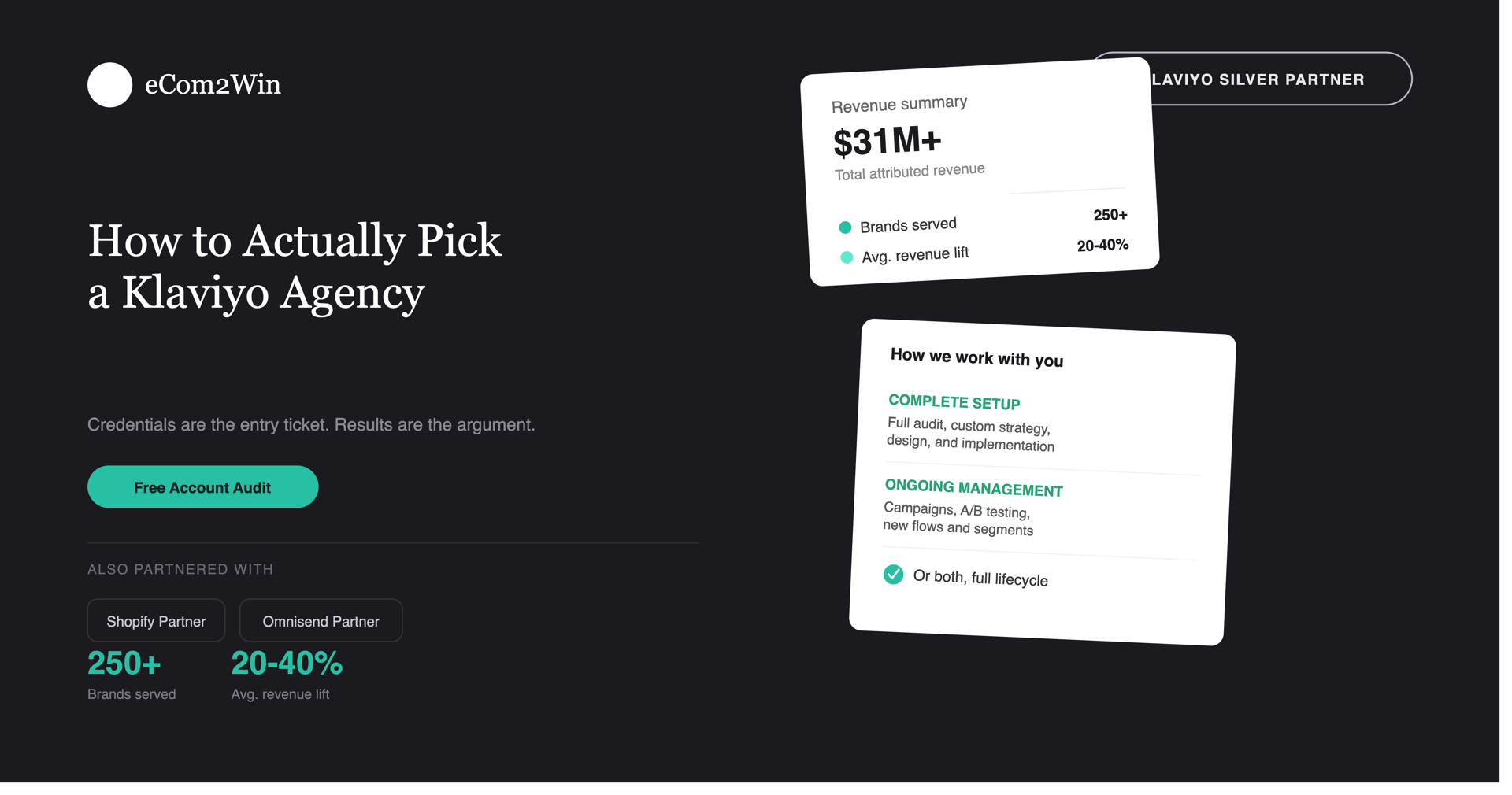
We're a Klaviyo Silver Master Partner, a Shopify Partner, and an Omnisend Partner. We mention it once, here, because you asked what to look for, not because it's the pitch. The actual pitch is $31M+ generated for 250+ eCommerce brands, and clients who typically see email and SMS climb to 20-40% of total store revenue. Credentials are the entry ticket. Results are the argument.
If the first move isn't an audit, that's the tell
Ask any agency what happens in week one. If the answer is "we start building flows," walk away. You cannot fix what you haven't measured, and an agency that skips straight to building is either guessing or reusing the same setup on every account they touch.
A real audit looks at what's actually happening in your account: which flows exist and which ones are dead weight, where segments have gone stale, where revenue is leaking between campaigns and flows, what your content is like, and what your customers are actually doing that your current setup ignores. Everything after that — welcome flows, abandoned checkout, post-purchase, winback, whatever else the data calls for — gets built from a full strategy shaped around what the audit found. Not a template. Not "best practice" flows copy-pasted from the last client.
Segmentation isn't a setup task. It's a maintenance job.
This is where most Klaviyo accounts quietly bleed revenue, and almost nobody catches it because the account still "looks" fine. Broad segments — "everyone who bought in the last 90 days," "engaged subscribers" — feel like segmentation, but they're really just smaller versions blasting your whole list.
Real segmentation moves with the customer. It updates as people browse, buy, ignore, or go quiet, and it decides send timing based on how that specific audience actually shops, not a Tuesday/Thursday calendar picked because it's convenient for the agency managing five other accounts the same way. If your segments haven't changed since they were built, they're not segments anymore. They're just smaller lists.
Ask to see revenue, not open rates
Open rates aren't meaningless — a low one is usually telling you something, whether that's weak subject lines or a deliverability problem worth digging into. But they're a diagnostic, not a scoreboard. They don't tell you whether the channel is making money, and an agency that only focuses on open rates in your monthly report is showing you the metric that's easiest to make look good, not the one that matters.
What you want is to know if there is revenue coming in, if the account is healthy, and whether those numbers are moving month over month. If a report leans on opens more than revenue, ask why — there's usually a reason, and it's not a good one. It might just mean the deliverability side is being ignored.
Frequently asked questions
Not sure if your Klaviyo account is set up right?
Book a free audit call and we'll show you where the revenue gaps are.
Book Your Free Strategy Call