How eCommerce Brands Can Generate 20+ Percent of Their Revenue From Email (What Type of Flows Actually Work)
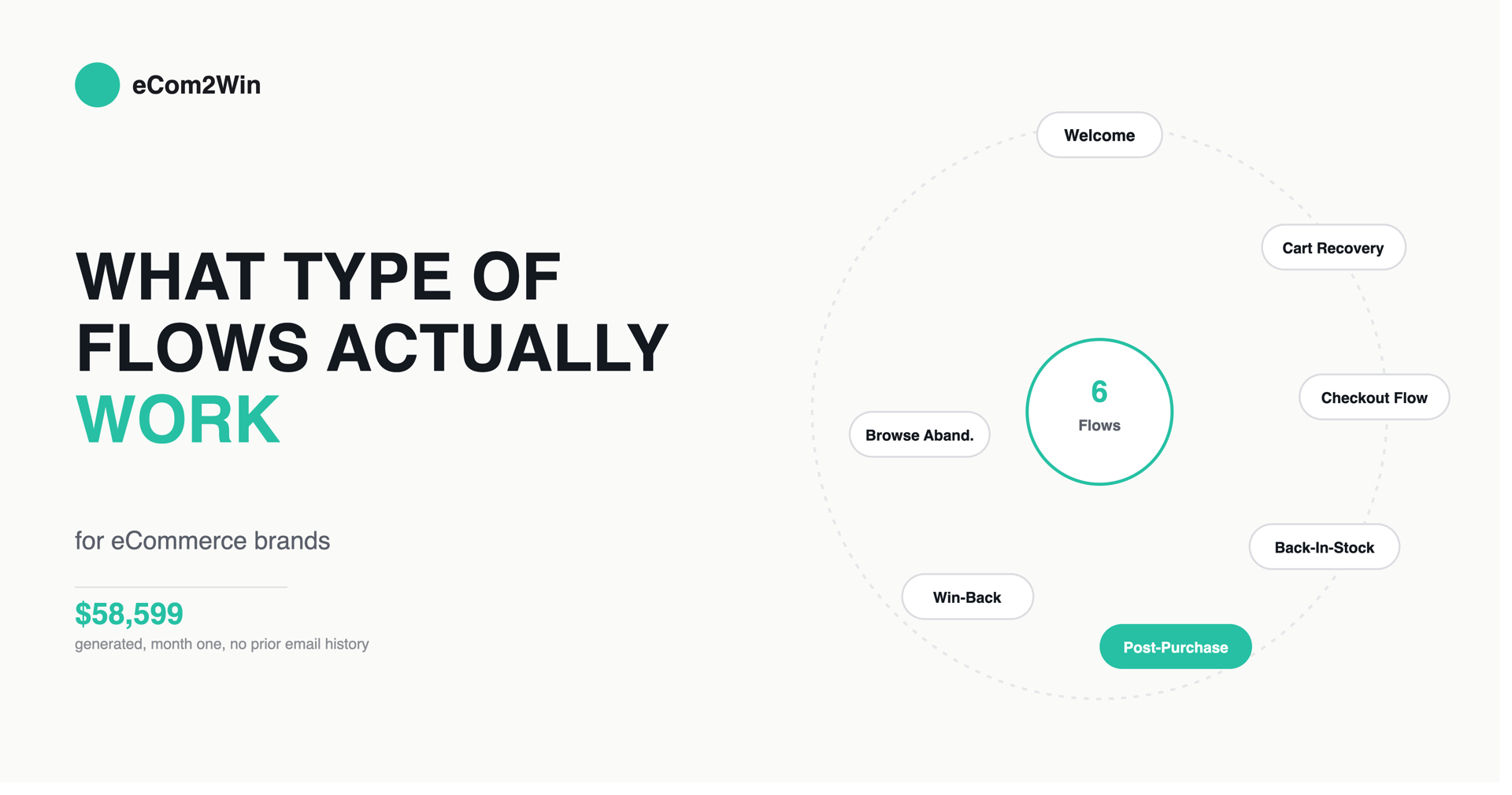
One Australian eCom store eCom2Win took on with no prior email strategy generated $58,599 in attributed revenue in its first month on Klaviyo. This did not come from a few clever campaigns alone or a bigger send volume. It came from flows built around how customers actually move through the funnel.
We see mentions of open rates and subject lines. In reality the number comes from two engines working together: campaigns, which drive the bulk of total email revenue through reach and timing, and flows, which quietly convert behavior into revenue at a fraction of the send volume. Most brands pour all their attention into campaigns and barely build the flows, which is exactly backwards from where the easy, compounding gains sit.
Why flows carry most of the weight
A campaign is a broadcast. It reaches your whole list at the same moment regardless of where any individual is in their relationship with the brand. A flow is triggered by behavior: someone subscribes, adds a product to cart, starts checkout, receives a delivery, or goes quiet for 90 days, and fires at the exact moment that behavior happens.
That timing is why flows punch so far above their weight. Klaviyo's own benchmark data across 183,000+ brands shows automated flows generating roughly 41 percent of total email revenue from just over 5 percent of total sends, with revenue per recipient running close to 18 times what a standard campaign produces. Campaigns still generate the larger share of total email revenue, because they reach the whole list and carry promotions, launches, and seasonal pushes that flows can't. But flows produce dramatically more revenue per email sent, which is why an account that neglects them is leaving the most efficient revenue in the business on the table. The two work together: campaigns for reach and moments, flows for the high-intent conversions that happen automatically in between.
The flows that actually drive the revenue
Welcome series. This is the highest-intent window a subscriber will ever give a brand, they just opted in voluntarily. A single "here's 10% off" or "Free gift" email captures a fraction of that attention. A welcome series spread across 5 to 7 days, brand story and product education first, social proof next, offer reinforced last, consistently outperforms a one-email approach because it earns trust before it asks for the sale. Segmenting the entry point matters here too, someone who signed up via a discount popup has different intent than someone who subscribed at checkout, and treating them identically leaves revenue on the table. Well-built welcome flows are frequently the single highest revenue-per-recipient flow in the account.
Abandoned checkout and Abandoned cart. These are two different flows, and treating them as one is one of the most common ways brands leave money behind. Abandoned cart triggers when someone adds a product and leaves. Abandoned checkout triggers when they actually start the checkout process, entered their details, and stopped one step short of paying. Checkout abandoners are further down the funnel and carry higher intent, so that flow typically earns even more per recipient. For both, timing is the single biggest lever: a first email sent within an hour recovers meaningfully more revenue than one sent 24 hours later, because purchase intent decays fast. A short sequence, reminder first, objection handling (shipping, returns, sizing, reviews) second, incentive only at the end if at all, consistently outperforms a single "you left something behind" email.
Browse abandonment. The flow most commonly missing when eCom2Win audits an account, and one of the biggest missed-revenue opportunities because of it. Lower intent than cart abandonment, but a far larger audience triggers it, since browsing happens long before adding to cart. Even a modest conversion rate against that volume adds up to real incremental revenue that a cart-only setup simply never touches.
Back-in-stock. The most overlooked high-revenue flow of all. When a customer asks to be notified that a sold-out product is available again, they've told you exactly what they want and when they're ready. Intent doesn't get more explicit than that, which is why this flow routinely posts one of the highest revenue-per-recipient figures of any automation, often above abandoned cart. Any brand that runs out of stock on popular SKUs and isn't capturing those requests is walking past some of the easiest revenue in the account.
Post-purchase. One of the most underbuilt flows in ecommerce, and one of the highest-leverage for long-term revenue. The window right after delivery is a high-trust moment, the customer just got what they paid for. Many stores stop at a bare shipping confirmation. A fuller sequence, usage tips, a genuine check-in, a review request timed to peak satisfaction, then a relevant cross-sell, is what turns a one-time buyer into a repeat customer. For consumable products, a replenishment reminder timed to when someone is likely running low turns that repeat purchase into predictable, recurring revenue.
Win-back. Recovering a lapsed customer costs close to nothing, since acquisition was already paid for the first time around. This is also the lowest-engagement flow in almost every account, because it's reaching people who have already disengaged, so it earns its place through volume and margin, not conversion rate. A win-back sequence that actually shows what's changed since the customer's last visit, before eventually introducing an incentive, tends to outperform a plain "we miss you" email.
What this looks like in practice
At eCom2Win, one brand grew from 6 percent to 37 percent of total revenue through email within 2 months, after adding these flows, setting them up with the right splits that cover the customer's journey and segmentation rebuild. Another grew from 9 percent to 50 percent after a complete account overhaul, more than five times what email was contributing before. A brand with no prior email strategy generated $58,599 in attributed revenue in its very first month on Klaviyo.
These aren't outliers. They're what happens when the flows above are built around how a specific brand's customers actually behave, not copied from a template.
The real signal to watch
If email is sitting well under 20 percent of total store revenue, the gap is almost always structural, and more often than not it's the flows, since that's where most brands under-invest. But a healthy program needs both halves running well: a consistent, well-segmented campaign calendar driving reach and promotional revenue, and a full set of flows converting high-intent moments automatically underneath it. Brands generating serious revenue from email aren't choosing one over the other, and they aren't just sending more email. They've built the infrastructure that delivers the right message to the right person at the right moment, on both the campaign and the flow side.
Frequently asked questions
Not sure if your flows are actually built right?
Book a free audit call and we'll show you where the revenue gaps are.
Book Your Free Strategy Call